
Nam ut nibh sed nisl molestie pulvinar a a justo. Vestibulum turpis leo, lobortis a diam in, dictum pretium nibh. Mauris fermentum, neque sed interdum condimentum, turpis felis semper quam, vitae mattis nisl nulla non urna. Suspendisse potenti.
We connect to those who are like us (homophily) and sometimes become more alike (diffusion).
The idea that our social ties shape what we do is, of course, is not limited to just migration behavior. With Paul DiMaggio, we have explored the linkages between homophily (the tendency to associate with people who are similar to us) and adoption of Internet use the United States. Combining agent-based simulations and empirical data, we showed that the gap between groups in Internet use at home is not merely due to differences in economic resources, but also a result of segregated social networks.
Homophily and diffusion can increase social inequality.
If we choose our friends based on their similarity to us (homophily), and if we are likely to do as they do (diffusion), then we all live in social islands. For those of us with advantages in life, having friends similar to us brings more advantages. But, this dynamic also makes those advantages more concentrated, and ultimately increases inequality.
With Paul DiMaggio, we explored the conditions under which homophily and network-based diffusion would exacerbate social inequality. We illustrated these ideas with simulations and empirical analysis.
With Linda Zhao, we added another element to the equation—consolidation, that is, the correlation between different traits. In a highly consolidated worlds, if I know your education, for example, I can easily guess your income. We found that consolidation and homophily interact in their effect on diffusion, and ultimately, on inequality.
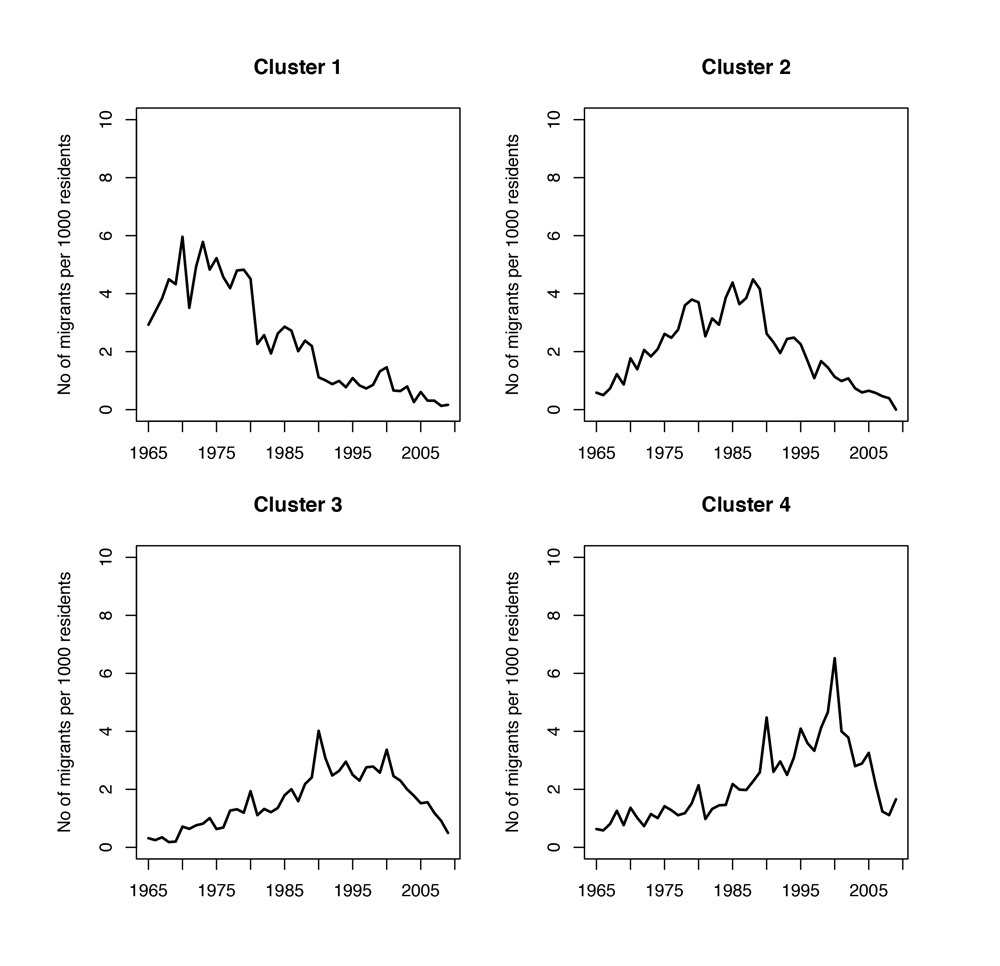
Cluster Figure
Inspiration on this subject
Watts, Duncan J. Six degrees: The science of a connected age. WW Norton & Company, 2004.